progress_activityLoading
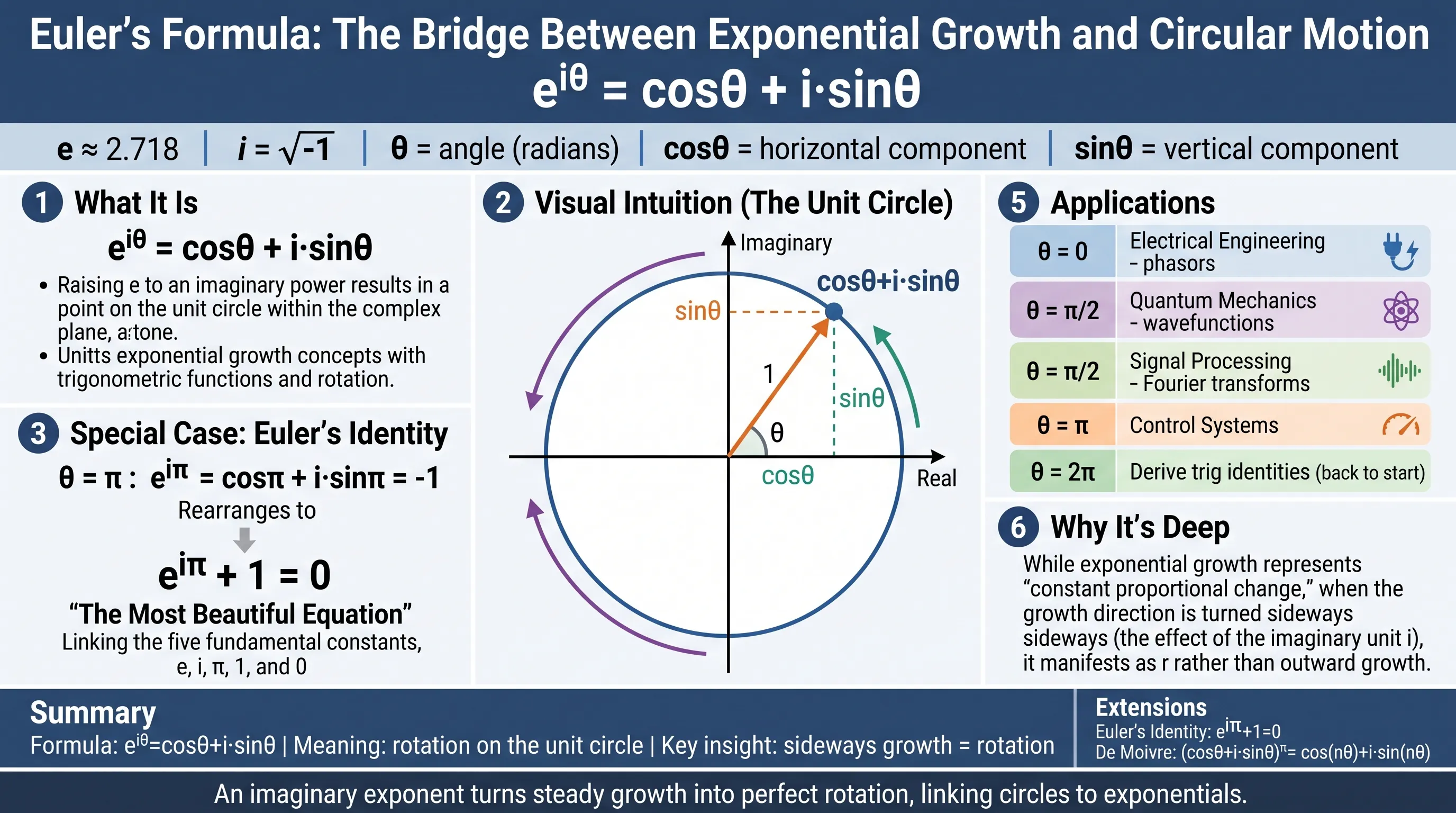
# Euler's Formula e^(iθ) = cosθ + i·sinθ "Complex exponentials connect exponential growth with circular motion." Notation: e ≈ 2.718 | i = √(-1) | θ = angle (radians) | cosθ = horizontal | sinθ = vertical. ## 1 What It Is For any real θ: e^(iθ) = cosθ + i·sinθ. Raising e to an imaginary power gives a point on the unit circle in the complex plane. Unites exponentials (growth) with trig functions (rotation). ## 2 Visual Intuition (Unit Circle) Point moving around radius-1 circle: x=cosθ, y=sinθ. Complex number cosθ+i·sinθ traces the circle. As θ increases, point rotates CCW. Diagram: unit circle with Real/Imag axes, radius at angle θ, projections to axes. ## 3 Special Case (Most Beautiful Equation) θ=π: e^(iπ) = cosπ + i·sinπ = -1 → e^(iπ)+1=0. Links five constants: e, i, π, 1, 0. ## 4 Numerical Examples θ=0 → 1 | θ=π/2 → i | θ=π → -1 | θ=2π → back to start. ## 5 Applications Electrical engineering (phasors), quantum mechanics (wavefunctions), signal processing (Fourier), control systems, deriving trig identities. ## 6 Why It's Deep Exponential growth is "constant proportional change" — when the growth direction is sideways (imaginary), you rotate instead of growing. ## Summary Formula: e^(iθ)=cosθ+i·sinθ | Meaning: rotation on unit circle | Key insight: growth sideways = rotation. ## Extensions Euler's Identity: e^(iπ)+1=0 | De Moivre: (cosθ+i·sinθ)^n = cos(nθ)+i·sin(nθ). One sentence: An imaginary exponent turns steady growth into perfect rotation, linking circles to exponentials.

Euler's Formula: Connecting Imaginary Exponentials to Unit Circle Rotation

User Avatar

@Meso Happ (Meso)

🔥 0 Remixes💾 0 Saves📤 0 Shares

TECHNICAL SPECS

MODEL

Nano Banana 2

ASPECT RATIO

16:9

QUICK REMIX

1505/2000
ADVANCED EDIT
Commercial usage license included

Similar styles you may like

#text_to_image
No recommendations available