progress_activityLoading
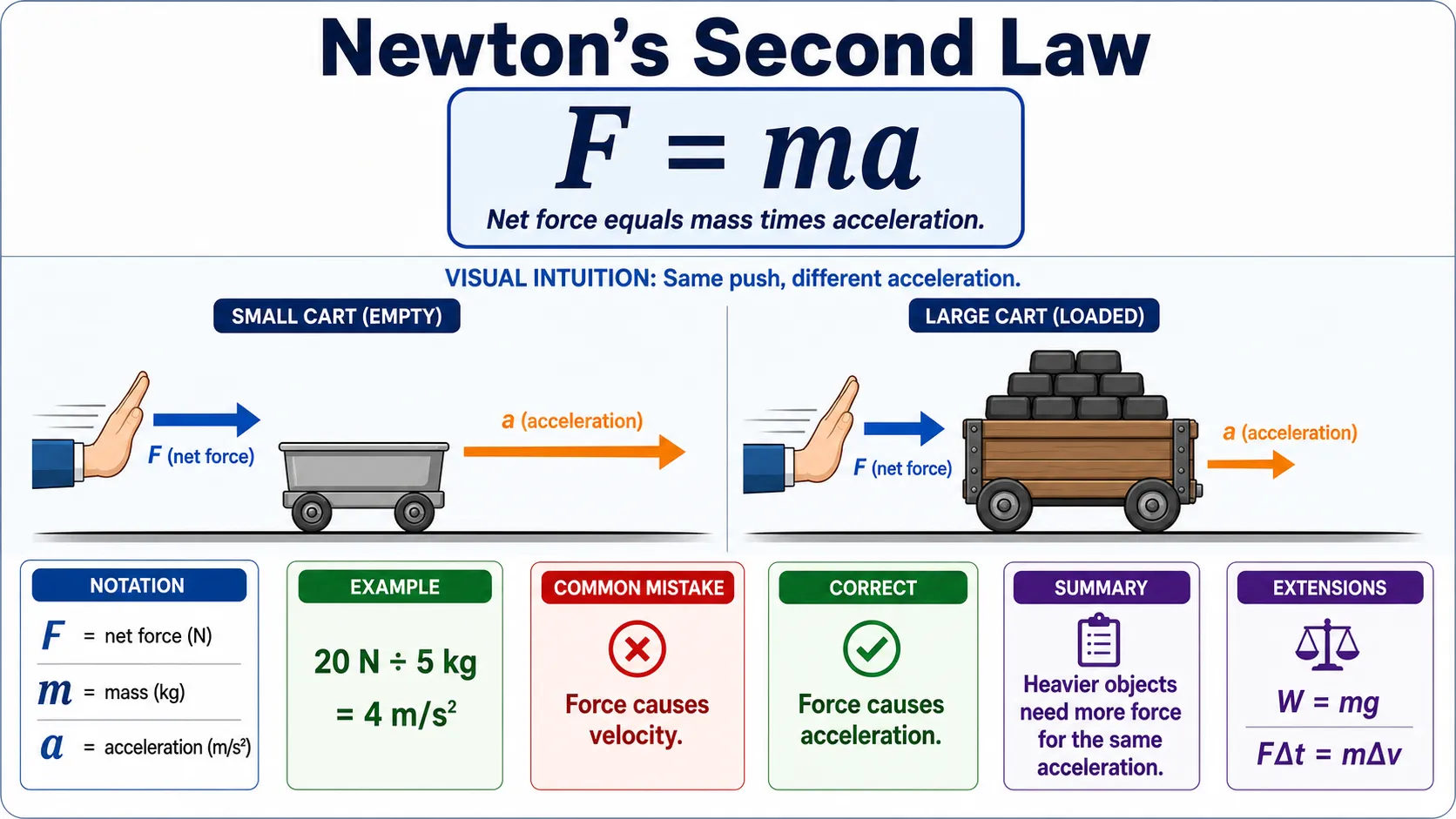
# Newton's Second Law F = ma "Net force equals mass times acceleration." Notation: F = net force (N) | m = mass (kg) | a = acceleration (m/s²) | F and a point same direction. ## 1 What It Is For constant mass: F = ma. Force causes change in motion. More mass = more force needed for same acceleration. ## 2 Visual Intuition Push an empty cart → accelerates easily. Push a loaded cart → same push gives less acceleration. Diagram: hand pushing small vs. large cart with acceleration arrows (long vs. short). ## 3 Breakdown F: net external force (vector sum) | m: inertial mass (resistance to change) | a: rate of velocity change. If F=0 → a=0 (Newton's First Law). ## 4 Numerical Example 5 kg box pushed with 20 N: a = F/m = 20/5 = 4 m/s². ## 5 Applications Vehicle design, sports, rockets, safety engineering (airbags), everyday pushing/pulling. ## 6 Common Mistake ❌ "Force causes velocity." ✅ "Force causes change in velocity (acceleration)." Constant velocity → net force = 0 (friction balances push). ## Summary Formula: F=ma | Meaning: force changes motion | Heavier = less acceleration for same force. ## Extensions Weight: W=mg | Impulse: FΔt = mΔv. One sentence: Force is what changes motion, not what keeps it going — and big things need more force to change.

Newton's Second Law F=ma: Force, Mass and Acceleration Intuitive Diagram

User Avatar

@Meso Happ (Meso)

🔥 0 Remixes💾 0 Saves📤 0 Shares

TECHNICAL SPECS

MODEL

Vidoly 1.5

ASPECT RATIO

16:9

QUICK REMIX

1268/2000
ADVANCED EDIT
Commercial usage license included

Similar styles you may like

#text_to_image
No recommendations available