
Can ChatGPT Really Do AI Virtual Try-On? We Tested It vs. Vidoly (With Real Examples)
 By Vivi/1 min read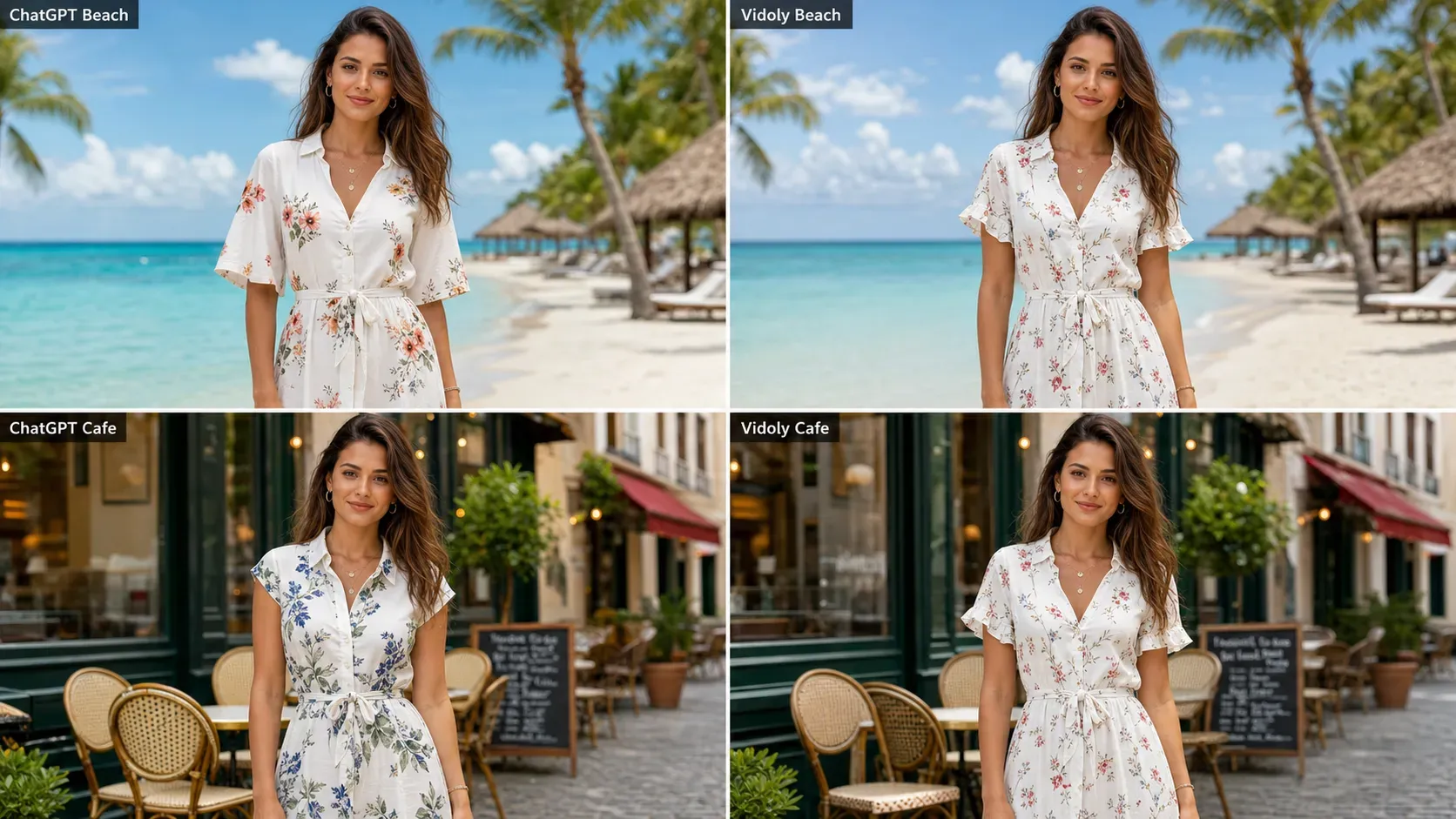
Want to put your clothes on an AI model? We put ChatGPT and Vidoly to a real test using the exact same model and dress. See the visual results, fabric details, and identity tests before you choose.
Can ChatGPT Really Do AI Virtual Try-On? We Tested It vs. Vidoly (With Real Examples)
Want to put your clothes on an AI model? We put ChatGPT and Vidoly to a real test using the exact same model and dress. See the visual results, fabric details, and identity tests before you choose.
The 10-Second Takeaway
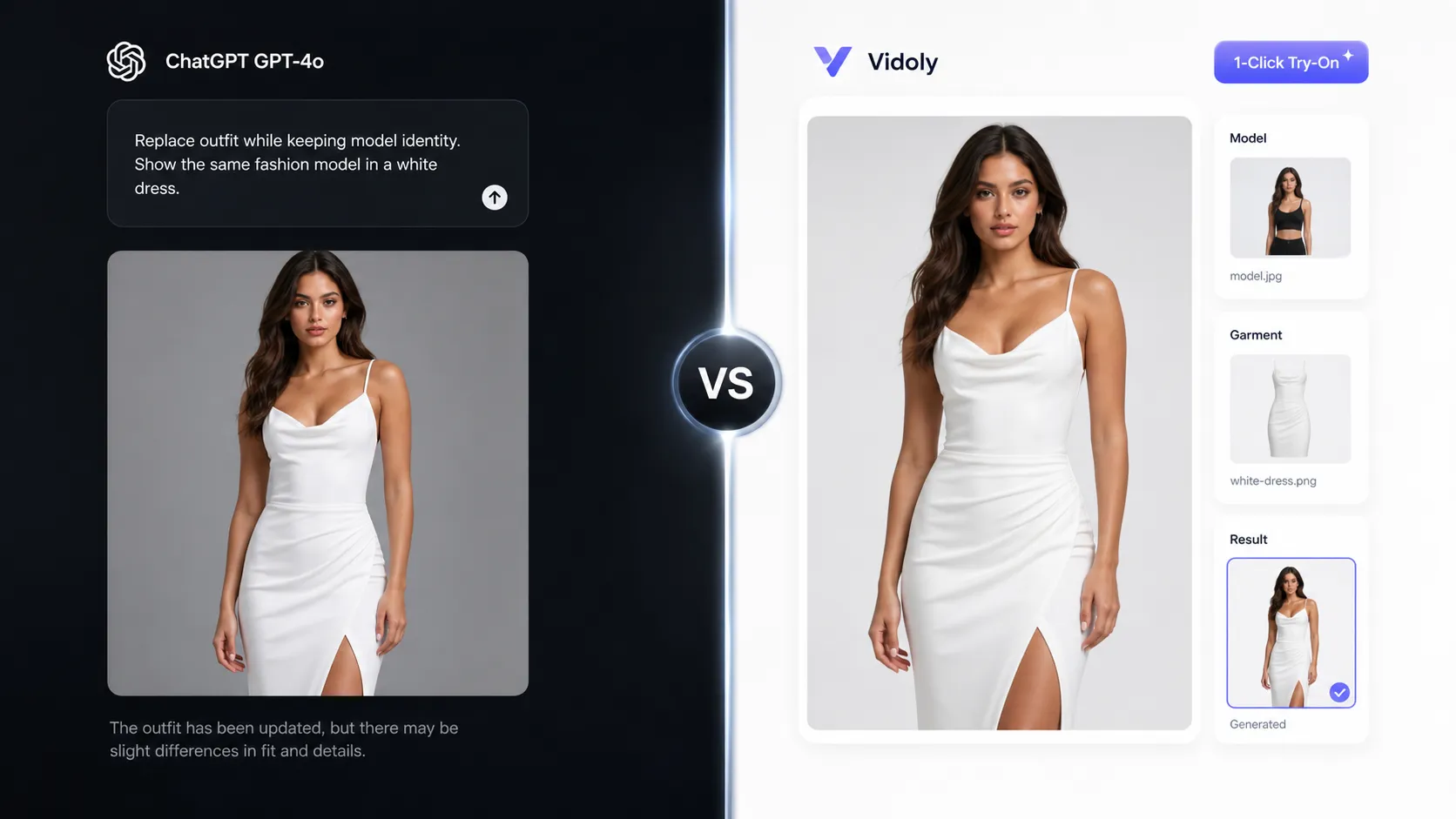
- ChatGPT: Great if you just want visual fashion inspiration or creative concept art. But if you upload a photo of your dress, it won't copy it exactly—it reimagines a "similar-looking" dress and often changes your model's face. Plus, you have to write long text prompts.
- Vidoly: Built specifically as an automated AI Virtual Try-On solution for real clothing stores. You just upload the model photo and your dress photo, click generate, and it snaps the exact garment onto the model without changing her face or altering your clothes. No prompts needed.
The Big Question: Can You Just Ask ChatGPT to Put Clothes on a Model?
If you run an online clothing store, sell on Shopify, or post fashion content on Instagram, you've probably tried typing this into ChatGPT:
"Here is a model. Here is a floral dress. Replace the model's outfit with this dress."
It sounds simple enough, but does ChatGPT actually give you a photorealistic result you can publish on your store? Imagine uploading an AI-generated photo to your store, getting 50 orders, and then having 40 of them returned because the lace trim or print on the real dress didn't match the picture. That's the hidden trap of relying on general-purpose AI generators.
To find out how well general tools perform compared to dedicated software, we ran a direct visual test using identical inputs:
1. The Model Photo: A simple, front-facing studio portrait of a female fashion model.
2. The Garment Photo: A white summer midi dress featuring micro-floral prints and puff sleeves.
Here is what actually happened when we put both platforms side by side.
Test 1: How Easy Is It to Get a Result? (Workflow & Ease of Use)
First, let's look at what you actually have to do to get a production-ready picture.
Working with ChatGPT:
1. Upload your model photo.
2. Upload your dress photo.
3. Write a long prompt explaining what to keep and what to change (e.g., "Keep the pose, keep the face, swap the outfit...").
4. Wait for generation.
5. Realize the model's face changed or the sleeves look distorted.
6. Rewrite your prompt and try again.
Working with Vidoly:
1. Upload your model photo.
2. Upload your dress photo.
3. Click Generate.
4. Done.
The Verdict: If you hate typing out complex AI prompts or playing guessing games with text boxes, using a dedicated virtual try-on tool like Vidoly is noticeably easier and faster. ChatGPT requires active prompt engineering and manual trial-and-error.
Test 2: The Dress Test (Does It Keep Your Actual Garment Details?)
This is where general AI image generators struggle most.
When you sell clothing online, your AI model photos must match what you actually ship to the customer. If the AI changes your dress pattern, alters the neckline, or smooths out seams, customer return rates will spike.
What Happened in the Test:
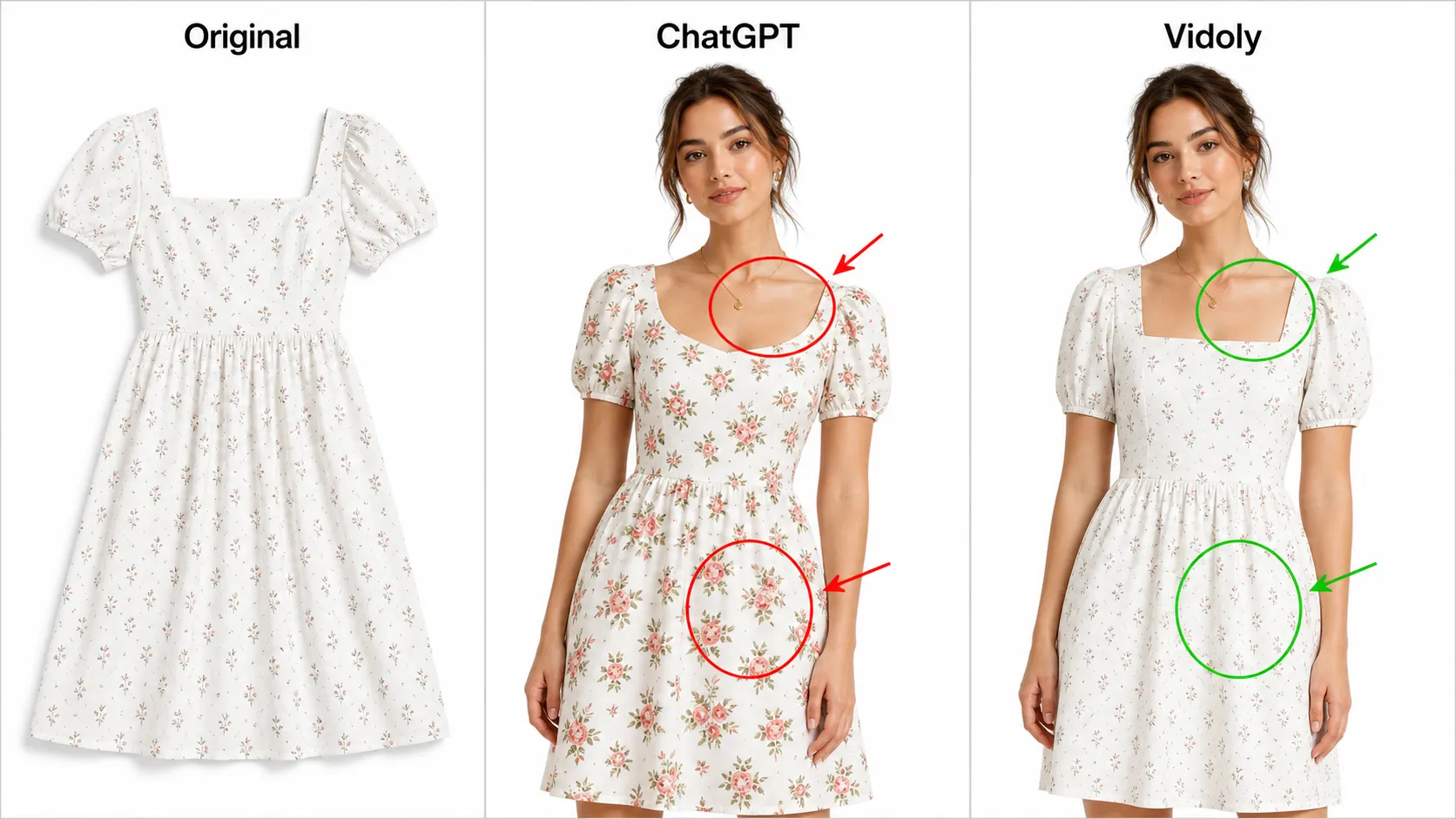
• ChatGPT Result: Generated a beautiful image, but it redesigned the dress. The small floral patterns became larger, the square collar got smoothed into a scoop neck, and the sleeve seams were moved. It made a dress that looks inspired by yours, but it's not your dress.
• Vidoly Result: Wrapped your exact garment file onto the model's body. The flower placements, square collar geometry, and puff sleeve boundaries matched your original product asset pixel for pixel.
The Verdict: If you are showing real products to real customers on a Product Detail Page (PDP), Vidoly preserves the exact product SKU. ChatGPT acts more like an artistic painter who reimagines your clothes.
Test 3: The Face Test (Does the Model Still Look Like the Same Person?)
If you're creating a seasonal lookbook or an Instagram feed, you need brand consistency across photos. That means using the exact same model face.
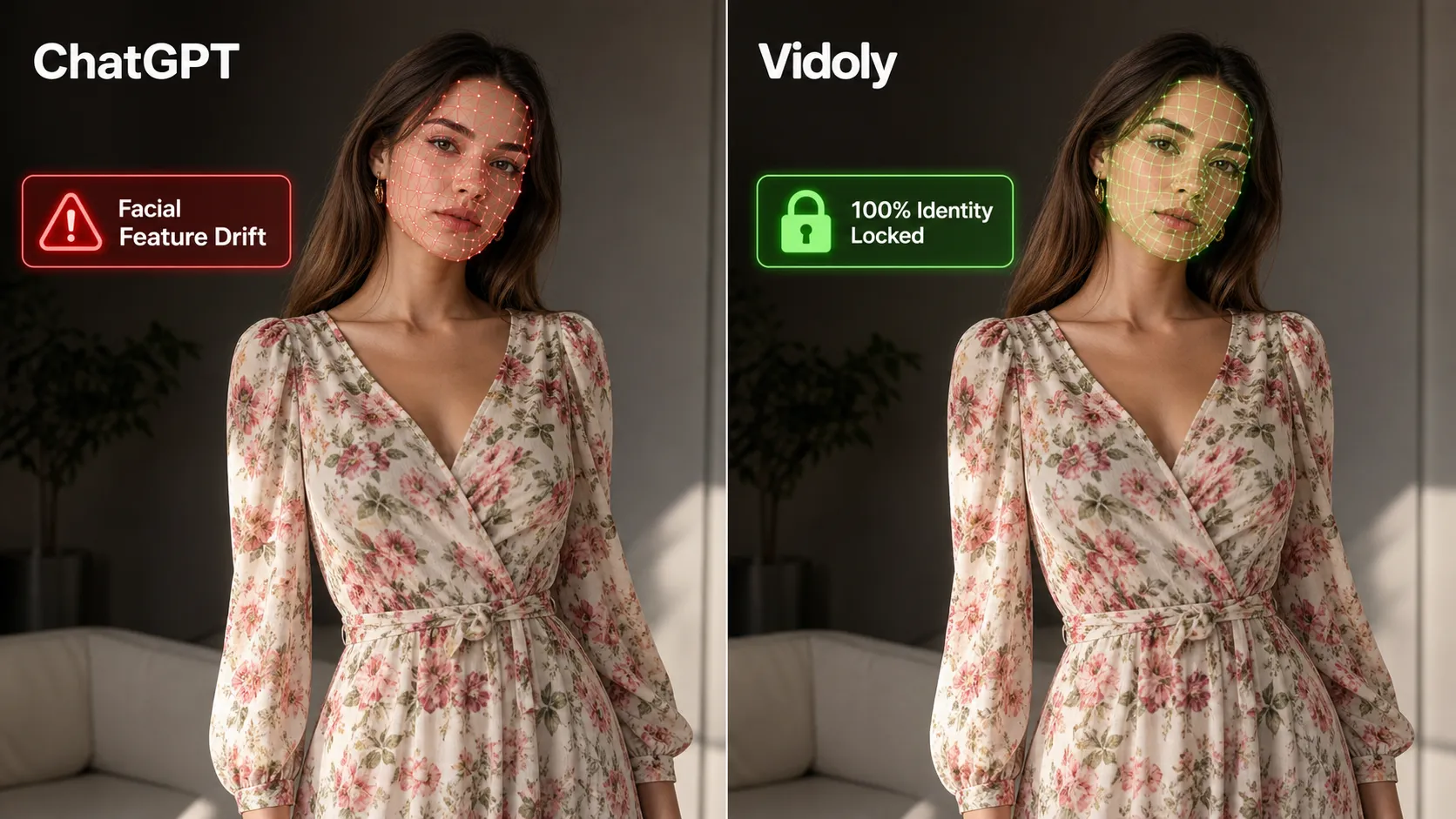
What Happened in the Test:
• ChatGPT Result: As soon as it put the new dress on, it slightly tweaked the model's eyes, skin tone, and jawline to match the "vibe" of the new image. She looks nice, but she no longer looks like the exact same person from your original photo.
• Vidoly Result: Employs facial landmark protection. Only the clothing layer changes—the model's face, hair texture, skin tone, and pose stay 100% identical.
The Verdict: For consistent brand marketing and multi-garment catalog shoots, Vidoly locks model identity without facial drift.
Test 4: Can You Put the Outfit in Different Locations?
What if you want to feature the exact same dress across diverse background scenes (e.g., a studio shot, a tropical beach resort, or a street cafe)?
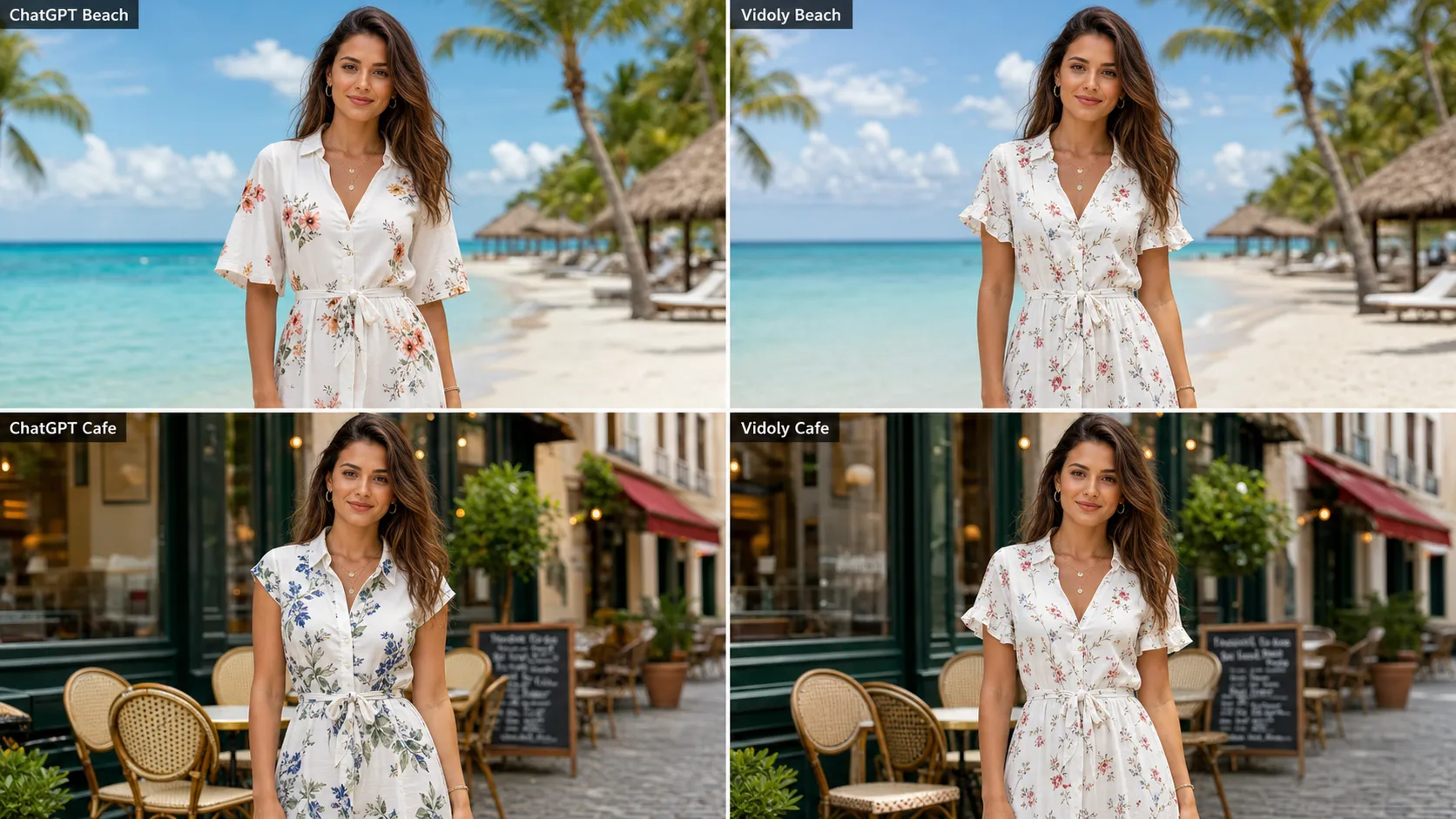
• ChatGPT: When you ask ChatGPT to change the background to a beach, it treats it as a brand-new artistic prompt and alters the dress design again to match the beach lighting.
• Vidoly: Keeps your garment and model locked while swapping out the surrounding lifestyle background, letting you test multiple ad variations for the exact same product.
Side-by-Side Breakdown: Which AI Tool Fits Your Need?
Here is a quick comparison guide to help you choose the right workflow:
| Your Primary Goal | Best Recommended Tool | Key Reason |
|---|---|---|
| Sell real apparel on Shopify, Amazon, or TikTok Shop | Vidoly | Keeps exact dress patterns and fabric details to prevent false advertising. |
| Explore wild creative concepts & mood boards | ChatGPT | Excellent at generating open-ended fashion artistic direction from text. |
| Create virtual try-on images without writing prompts | Vidoly | 1-click photo upload pipeline with zero prompting required. |
| Produce consistent multi-product lookbooks | Vidoly | Locks model face and body identity across hundreds of catalog SKUs. |
| Generate artistic fashion illustrations | ChatGPT | Great for abstract silhouettes and prompt-driven art experiments. |
Frequently Asked Questions (FAQ)
Q1: Can ChatGPT do virtual try-on for free?
You can upload photos to ChatGPT and ask it to swap clothes, but because it relies on general image generation rather than garment mapping, it won't preserve exact product patterns or brand logos.
Q2: Why does ChatGPT change my dress design when I try on clothes?
ChatGPT doesn't "fit" your original photo onto a body mesh. Instead, it looks at your picture, interprets it creatively, and draws a brand-new image from scratch. That's why micro-prints, collar shapes, or stitching often get altered.
Q3: Do I need professional camera equipment to prepare my clothes for AI try-on?
No. You don't need expensive studio equipment. A clear smartphone photo taken under bright, natural light against a neutral wall or flat surface works perfectly when using Vidoly's AI Virtual Try-On studio.
Q4: Do I need to learn prompt engineering to use Vidoly?
No. Vidoly eliminates prompt engineering entirely. You simply upload your model asset, upload your clothing photo, and the system processes the try-on output automatically.
Final Thoughts
• Choose ChatGPT if you're looking for early-stage creative brainstorming, conceptual art, or visual inspiration where exact product accuracy doesn't matter.
• Choose Vidoly if you need an operational, ecommerce-ready AI Virtual Try-On generator—where keeping your actual clothes accurate, preserving model identity, and skipping prompt engineering are what matter most.
Ready to see how your own products look on real models without writing a single prompt? Try out Vidoly AI Virtual Try-On today and transform your product catalog photos in seconds!
Related Articles
Free Photo to Sketch AI Generator: Convert Any Photo to a Pencil Sketch Online
AI Art Generator: Turn Photos into Oil Paintings with AI (Free Online Tool)
Free AI Logo Generator: Create Professional Logos Online in Seconds (2026 Guide)